Monday, May 16, 2011

What Cleaning Supplies Do You Have?

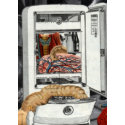
I found this vintage photo of a woman with her cleaning supplies really interesting...Notice how many brushes and tools she has, the few bottles... Soap and water, elbow-grease, individual tools to clean specific surfaces, shapes to reach the right places, that's how you clean.


I was just discussing this issue with the kids -- how today's so-called consumer products of convenience aren't really cleaning products at all. The easy-peasy Swiffers etc. are sold on the idea that you only need one tool in your cleaning kit -- but that's false.

What these things do, by and large, is just wipe things off. It's like my dad used to admonish my sister and I when we cleaned as young girls: "You girls aren't cleaning; you're just rearranging dirt."

Now dad was a military guy (the navy), and while he did have a few anal requests (such as a particular way his undies had to be folded), he wasn't about hospital corners on beds. But he did want clean. It was part of his work ethic: a job worth doing was worth doing well. This was something both he and my mother instilled in us.

How they did this in terms of cleaning was to teach us how to clean and then supervise us doing our chores. Once they were satisfied we could achieve the proper results, we were left alone to do them. (I wouldn't be surprised to learn that they came back later to check the results; but by then we knew if we had done a poor or rushed job and expected comments on poor performances -- and knew we'd have to go back and do it right. But we might still have gotten out earlier on Saturday night to reclean on Sunday.)

I remember being supervised during my chores... It was unnerving. But it also instilled a great pride too.

I vividly recall one time when my father watched me sweeping the kitchen. It was that texturized linoleum with a pattern on it (in avocado green, of course), sold on the idea of camouflaging dirt. (No, dad didn't buy it; it came with the house.) It was difficult to sweep and wash because the pattern did hide the dirt, and was rather dizzying, nauseating to look at. So I developed a method to ensure I never missed a spot.

I took the broom and began on one side, right up against the wall, and swept down the full length of the room, leaving a pile of the dust & dirt at the far wall. Then I walked back to where I had started and, one broom length away from the wall, repeated the same sweep pattern. Over and over I did it this way until I had done the full kitchen. Then I went back to the far wall and swept along that edge to get all the dust & dirt into the dustpan.

One day while doing this, I was surprised to look up and find my dad watching me. I was in junior high/middle school by this time and it had been years since he'd supervised my chores.  But this was a new house I was cleaning. Was he going to stare at me while I did all my chores?

I (rather snottily) asked him what he was watching me for and he replied that he was fascinated with how I was sweeping.  Still feeling defensive, I told him I couldn't see the dirt on the floor and I didn't want to lose my spot in the busy pattern and miss some dirt. He replied it was a brilliant plan -- and that he planned to use it himself.  Beaming with pride, I then replied that when I scrubbed the floor (because no, we didn't sponge-mop!), I used the same pattern, modified in smaller sections. (That would be harder to describe without a diagram lol). But my point is, I was really proud of being complimented on how well I cleaned -- on not "just moving dirt around."

My other point is, getting back to the photo, that too many people have sacrificed clean for the sake of convenience.  If you don't have at least half of what this lady does (and the mop doesn't count!), if you have a vacuum, a mop, a bucket, a sponge, some Swiffer-esque things (one for dusting and one for floors), and an array of cleaning product bottles and cans, you are not cleaning -- you are just rearranging dirt.

Now, confess, what's in your cleaning kit, what's missing from it?

Monday, May 9, 2011

Save Money & Make Money With Coupons, Rebates, Etc.

In her post about vintage Las Vegas ephemera, Shawnee reminded me of something I've been intending to write about here: How to save money selling coupons, , etc. at eBay.

As I (frustratingly) confessed, I sell my unwanted gift cards at eBay; it's the fastest way to get paid and usually at top dollar. (Usually I get paid the same day I list the card and at 80% of the gift card amount, which is far better than those gift card sites -- so even if you can only sell one card at a time, it's more money in my PayPal pocket and faster too.) This is a great way to make money off your gift card reward programs.

But perhaps you didn't know you can also sell other bits of paper, plastic, and cardboard at eBay -- making green for your wallet and keeping the earth greener too by putting these things in the hands of those who will use them.

The paper, plastic and cardboard I'm talking about here are coupons, "points," and other consumer member reward program materials

Even if you participate in any coupon swaps (local, among friends, or groups on the Internet), selling your unwanted coupons etc. can bring you extra money.

(I'm now saving my-hated My Coke Punishments Rewards to sell them on eBay -- because money can be tight, but I can be bright. *wink*)

Of course, those of you into making use of coupons and rewards programs, extreme or not, can find bargains for you and your family too.

Save money with the coupons, use them for promotional proof-of-purchase offers, consumer reward programs and rebates -- or sell them for cash on eBay.

Image of a vintage pudding promotional offer via my Kitschy Kitschy Coo post.

Thursday, April 28, 2011

Crochet A Handbag With A Button Tab Closure

Instructions for crocheting this cute purse come from the February 1971 issue of The Workbasket.

Wednesday, April 27, 2011

Lemon Juice & Acidic Rubs For Fowl & Meats

This clipping from a vintage Modern Woman magazine (volume 17 number 1, 1948) recommends rubbing lemon juice into a fowl before roasting to make the meat more tender and to lighten it. I've heard/read lots of similar tips regarding lemon juice, tomato, and other naturally acidic foods (alone or in marinades) to tenderize meats (Hello, salisbury steak tomato sauce recipes for cheap tough cuts of meat!), but I don't recall anyone commenting on lightening the meat... Come to think of it, I've never heard anyone complain about meat that's "too dark" -- unless it was burnt *wink*


Tuesday, April 26, 2011

Unhappy Meals, Unhappy Relationships

I know the title sounds like this post is going to be about getting fussy kids to eat at meal time; but it's not. Well, at least not in terms of parenting. It's about all of us eating poorly and forging bad relationships -- not only with food in addictive ways, either, as you'll see...

Over at Kitchen Preserve (where there are some great recipes!), I was reading Rebecca's "about" page where I found this incredible bit:

The writer Michael Pollan says that we should not “eat anything your great great-grandmother would not recognize as food.” Pollan means that we should eat whole, natural, unprocessed foods.  But specifically, what did our great great-grandmothers eat?  Do you know?  I wish I knew more details of my ancestor’s recipes–but unfortunately no one ever wrote much down.
(Rebecca should read more vintage and antique cookbooks, magazines and publications -- she'd likely be surprised!)

In Pollan's article, Unhappy Meals, the author explores the history behind our current bad diets. The article is long, but absolutely recommended reading. Today, this part sticks out:
No one likes to admit that his or her best efforts at understanding and solving a problem have actually made the problem worse, but that’s exactly what has happened in the case of nutritionism. Scientists operating with the best of intentions, using the best tools at their disposal, have taught us to look at food in a way that has diminished our pleasure in eating it while doing little or nothing to improve our health. Perhaps what we need now is a broader, less reductive view of what food is, one that is at once more ecological and cultural. What would happen, for example, if we were to start thinking about food as less of a thing and more of a relationship?

In nature, that is of course precisely what eating has always been: relationships among species in what we call food chains, or webs, that reach all the way down to the soil. Species co-evolve with the other species they eat, and very often a relationship of interdependence develops: I’ll feed you if you spread around my genes. A gradual process of mutual adaptation transforms something like an apple or a squash into a nutritious and tasty food for a hungry animal. Over time and through trial and error, the plant becomes tastier (and often more conspicuous) in order to gratify the animal’s needs and desires, while the animal gradually acquires whatever digestive tools (enzymes, etc.) are needed to make optimal use of the plant. Similarly, cow’s milk did not start out as a nutritious food for humans; in fact, it made them sick until humans who lived around cows evolved the ability to digest lactose as adults. This development proved much to the advantage of both the milk drinkers and the cows.
Clearly living off the land, near the land, with the earth, is better for all who live on it.

It's not just the extra work we do preparing our foods that keeps us fit (even more so when we garden and grow our own food) or that cooking our own food keeps more of the natural nutrients in our food than processed food-stuffs does, but that we build relationships. Relationships with the cycle of life, the planet and those who inhabit it with us, and relationships with those we spend time growing, preparing and eating with.

I don't think it's possible or advisable for us all to be farmers and produce (grow and raise) all that we eat.  But I do think we'd benefit from asking ourselves if what we are putting into our bodies could actually be something we could produce.

If not, we probably shouldn't be eating it.

Which reminds me, will you be watching Jamie Oliver's Food Revolution tonight?

Tuesday, April 12, 2011

Airing Out My Thoughts On Clothespins

I was reading over at In The Labyrinth where these hand-painted clothespins from Made with Love by Hannah were posted -- and my head exploded with thoughts about clothespins.


First of all, as I noted here about these vintage "Clean-Grip" figural clothespins, plastic clothespins do not stain, discolor, or soil the wet laundry like wooden and/or metal clothespins can; plastic clothespins don't splinter either. However, because the plastic ones -- adorable vintage ones or not -- were more expensive, most of us are more familiar with the wooden varieties. [Put a (clothes) pin in that; I'll get back to the familiarity of clothespins in a bit.]

While these hand painted wooden clothespins are utterly charming, I do have some practical concerns... I don't see them for sale at the site, so I don't know if these are varnished or sealed in any way to prevent the paint from adhering to wet laundry -- or, for that matter, even to sticking to or rubbing off on on dry textiles. (Something that as a collector of textiles should consider before even using them indoors to display items.) But in any case, there are practical matters to consider regarding painted wooden clothespins.

That said...

I'm sure most of us recall the various craft projects involving painting wooden clothespins we did as kids. I vividly remember painting the traditional wooden clothes pins to look like soldiers, adding glitter and pom-pons at the top for hats, to make ornaments for the Christmas tree in Girl Scouts. I also remember most of us were not familiar with this form of clothespins; we were used to the wooden ones with metal springs. But we knew what clothespins where. And not in some abstract or crafting-only way either. Back then, we saw laundry hanging on the line to dry -- often we'd helped to put it there.

This is another one of those things I've seen change, nearly disappear, in my lifetime of 46 years.

It's not (just) that appliances were part of the consumption mentality marketed to Americans, but that as more women entered the workforce (either as women's libbers who sought careers, like my mother, or as the economy forced both parents to work outside the home) hanging the laundry outside to dry was no longer practical.

I don't recall the pivotal moment when the habit of hanging wet laundry outside to dry ended in my childhood -- but I do distinctly remember having a conversation with my mother, when I was an adult with a child of my own, that drove the point home.

One early spring day she had called me at home, around lunchtime as she often did then, and asked how the day was going. I had told her I had just finished hanging the laundry out to dry. She was so jealous I could hear it resonate over the phone as she talked about that being one of the first real signs of spring, how the sheets smelled so good...

I asked her why she didn't go home and do the same? She sighed and said even if she had started the load of laundry in the morning and drove straight home to hang the laundry outside, there wasn't enough time to have it dry before it was dark. Plus, there was dinner etc. to deal with then. And once, she did hang the laundry out to dry while she was at work, but it rained and what laundry hadn't been blown to the ground was still covered in dirt splashing up from the ground, etc. One really had to be home to notice the weather changes and respond to it.


So despite the sensual delights in hanging laundry out to dry, and the economic savings too, the whole practice has become one based on the luxury of time.

Nowadays, kids likely aren't even familiar with crafting with clothespins. In part because crafting isn't what it once was. And because now the plastic clothespins are cheaper than wooden ones. But maybe we can change that *wink*

Practical Fish Guide

This guide to cooking fish is from Fish Facts, copyright 1938, Ronald Lichter; courtesy of Schwarz Fish Co., Dealers in Fresh Fish & Sea Food, Sheboygan, Wisconsin. The spiffy thing is that it tells you if the particular fish is lean or fat, the best season or time of year, and the best ways to prepare it (broil; bake; boil, steam, poach; fry, saute).

Monday, April 11, 2011

A Tip on Cutting Meringue Pies Neatly

Another clipped tip from Modern Woman magazine, volume 17 number 1, 1948.

Wednesday, April 6, 2011

Quick List Links

I'd like to thank Mama Says for including Things Your Grandmother Knew in her list of Favorite Frugal, Simple, Green Living blogs.

Things Your Grandmother Knew also made the list of Top 50 Household Cleaning Blogs.

Monday, March 28, 2011

Make A Scrolled Wooden Wall Shelf

Instructions and pattern for a pretty wooden scrolled wall shelf from Deltagram (Volume 22, Issue 3, May / June 1953), published by Delta Mfg. Co., Milwaukee, Wisconsin. (Deltagrams are awesome sources for vintage woodworking projects.)

Sunday, March 27, 2011

Crochet A Chignon Cover

Instruction for crocheting a chignon cover using the open shell stitch; via Learn To Crochet, Coats & Clark book #210, 1971.

Things Your Grandmother Knew © 2008 Por *Templates para Você*