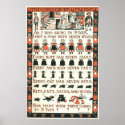
Clear illustrations on identifying common garden pests from 4-H Bulletin number 52, the 4-H Vegetable Gardener, from the Michigan State College Cooperative Extension Service, East Lansing. Second printing of First Revision, June 1953. NOTE: The suggested treatments may be vastly out of date. This is posted as a guide for identification.
Monday, April 6, 2015
How To Identify Common Garden Insects
Posted by Deanna Dahlsad
1 comments
Labels:
Gardening,
Guides
Saturday, March 21, 2015
Getting Ready To Garden? Simple 25-By-50-Foot Vegetable Garden Plan
Posted by Deanna DahlsadFrom a vintage 4-H vegetable gardening booklet comes this handy little chart on succession planting. While the veggie varieties are suitable to northern climates (specifically Michigan, where it was published) there are sound ideas for the beginning gardener.
Thursday, March 27, 2014
Economical Vintage Living Link Round-Up
Posted by Deanna DahlsadWinter isn't over where I live, is it over by you? For those of you struggling with propane shortages and costs, I've tried these wonderful eheat wall panel heaters -- and I love them!
Here are 5 simple ways to make your home a little greener.
Green thumb or not, antique seed planters still work!
Whether you are going green, reconsidering the healthy aspects of dryer sheets, or just want to save money by not using them, here are 7 ways to avoid static cling in the laundry without 'em.
Speaking "7", are you making these 7 recycling mistakes?
0
comments
Labels:
Gardening,
Health,
Household Tips,
Recycle,
Reviews
Wednesday, July 13, 2011
How To Freeze Peas
Posted by Deanna DahlsadFrom the Bureau of Home Economics, United States Department of Agriculture, 1952, how to freeze fresh peas from your garden.
Monday, July 11, 2011
Princess Peggy Pop On
Posted by Deanna DahlsadA 1952 ad for the Pop On from Princess Peggy -- "just Pop It On for a blouse, smock, apron... perfect for the hostess or gardener."
0
comments
Labels:
Clothing,
Entertainment,
Gardening,
Traditions,
Women
Sunday, July 10, 2011
Links Your Thrifty Grandmother Would Like
Posted by Deanna DahlsadHow does your garden grow? Information Central: Gardening Questions Answered, by Stephanie Suesan Smith, Ph.D.
Your grandmother would probably like Natural Practical Remedies: Your source for remedies that are practical and/or natural for you and the whole family.
Feel like saving more money? Check out Elemental Cheapness for more ideas.
Also, a contest to win a downloadable file of more than 150 pages of antique images from a 1914 New York Department Store catalog -- for you vintage lovers and creative types.
0
comments
Labels:
Bargains,
Contests,
Gardening,
Waste-Not
Wednesday, June 29, 2011
Build A Novel Wren House
Posted by Deanna DahlsadVintage bird house plan and pattern from that Deltagram (Volume 22, Issue 3, May / June 1953). (You can get this vintage publication for free; I've listed it at Listia!)
0
comments
Labels:
Crafty,
Don't Pay Do It Yourself,
Gardening
Saturday, June 25, 2011
How To Make A Hanging Tool Cabinet
Posted by Deanna DahlsadInstructions and pattern for a tool cabinet you hang on the wall. It would also be a good place to store crafting items, kitchen utensils and spices, gardening tools and supplies, and loads of other things you'd rather not just toss in a big drawer. (It has small drawers inside!)This vintage shop project is from that Deltagram (Volume 22, Issue 3, May / June 1953; published by Delta Mfg. Co., Milwaukee, Wisconsin), where we got the pattern and instructions for a scrolled wall shelf. (See also: How To Make An Elephant Ring Toss Game.)
Thursday, March 24, 2011
Tips On Tuberous Begonias
Posted by Deanna DahlsadTips on tuberous begonias from the February, 1971 issue of The Workbasket -- which reminds us that tubers may be started indoors in March or April.
0
comments
Labels:
Gardening
Monday, February 7, 2011
In Time For Valentine's Day, A Tip On Keeping Cut Flowers To Last Longer
Posted by Deanna DahlsadAnother tip from inside Modern Woman magazine (volume 17 number 1, 1948).
1 comments
Labels:
Gardening,
Household Tips,
Waste-Not
Friday, April 30, 2010
Is It Time To Return To Canning At Home?
Posted by Deanna DahlsadThe 1942 "Victory Recipe Edition" of Modern Homemaker (published by American Homemaker, Inc., which, based on the ads and content, could have been a Kerr Glass publication), is a WWII home front "Food For Victory" call for planting a Victory Garden.
Included is part of an address from then Secretary of Agriculture, Claude R. Wickard, which likely appeals today to farmers and gardeners alike:
It is our job NOW to prepare to meet the demand, not tomorrow or the next day, but right now. There is only one time to plant, and if you are not ready at the right time you have lost a year's production forever. There is no way to make it up.And Mrs. Alexander H. Kerr, President of the Kerr Glass Manufacturing Corporation, added her own strenuous message:
No great undertaking was ever won by the half-hearted efforts of a few. TO WIN THIS WAR it will take the united efforts of every red-blooded American man, woman and child TO PLANT VICTORY GARDENS... TO CAN THE SURPLUS... TO FEED OUR FAMILIES AT HOME AND OUR BOYS AND ALLIES ABROAD.I find the urgency of these messages a sad reminder of how disconnected most of us are from the current wars we fight -- and how many of us would find these old messages from World War II more akin to the plight of our current economy, to the threatened and vulnerable way we feel here on the home front. Whichever way these messages on the thrift and necessity of gardening and canning speak to you, I'm sharing the following information with you in the spirit of helpfulness. (As always, click the images for large scans.)
On page 6, information on the "careful study" which should be given to the kinds of fruits and vegetables to be planted. They direct you, whether planting on your own land or in a community garden, to see your County Agricultural Agent (which I suppose today, would be part of or akin to your local university &/or county extension offices) in terms of soil analysis, varieties best suited to your area, etc.

Other interesting notes from this page:
When a family produces its own vegetables it will eat more than if they came from the store and have to be paid for in cold cash. That of course tends to improve the family's health and enables members to work harder and longer. Producing vegetables at home puts the food right where it is to be used; it doesn't take any freight cars or trucks to move the food to those families. Still another advantage of home vegetable gardens is that they release more of the commercial vegetable production for other uses...On page 7, "Your 3 Step Victory Program" discusses your canning budget, complete with a chart for calculating how much to can for your family based on the "30 non-productive weeks of the year" (which obviously varies by your local as well). For each vegetable, fruit, meat, jams, etc., the number of weekly servings is translated into an amount for one person, which you then multiply by the number of people in your family to ascertain your canning needs.

Now I've never canned food before; most of us have not. Not only the ease of refrigeration, freezing, commercial canning, and commercial freezing, but the low cost, has rendered canning a thing of the past (hence the plethora of cheap glass canning jars at rummage sales, thrift shops, etc.). Aside from the proper supplies for sealing the jars, an increase in water and energy usage, the seeds etc. involved in gardening-- and the time spent in labor -- I'm not sure what else is involved... So I cannot speak for the costs (or ease) of canning. And I'm not even sure if canned food is better than commercially frozen, etc.
But when you figure in the environmental costs (as mentioned above) of buying groceries from the store and the positive benefits of you and your family working together side-by-side, both in the garden and the kitchen, the equation becomes a matter not simply of the amount of money spent today, but of the potential costs of tomorrow.
7
comments
Labels:
Food,
Gardening,
Guides,
Vintage Living,
Vintage Magazines
Sunday, January 31, 2010
Caring For Your Boston Fern
Posted by Deanna DahlsadThis tip about dealing with fern scale infestation comes from a vintage issue of The WorkBasket (likely the 1950's -- for some reason, the scan didn't make it into the right folder for issue number and date; sorry about that.)
0
comments
Labels:
Gardening
Tuesday, July 28, 2009
Truths About Fruit Tree Seedlings
Posted by Deanna DahlsadFrom a vintage issue of The Workbasket, the truths about getting fruits from fruit trees: don't get seedlings (unless you can wait years!), get grafted fruit trees.
3
comments
Labels:
Food,
Gardening
Thursday, June 11, 2009
White Molds That Grow On Flower Pots
Posted by Deanna DahlsadIn the March 1952 issue of The Workbasket, descriptions of white molds that form around flower pots, their causes and treatments.
0
comments
Labels:
Gardening
Monday, June 8, 2009
Tuberous Begonias Need A Rest
Posted by Deanna DahlsadInside a 1952 issue of The Workbasket, a reminder about maple leaf tuberous begonias (often sold in those hanging baskets this time of year):
0
comments
Labels:
Gardening
Monday, April 20, 2009
How To Waterproof Flower Pots & Planters
Posted by Deanna DahlsadA tip on preventing water rings from planters & flower pots on windowsills etc., from a vintage promotional booklet from Eddy's Bread.
0
comments
Labels:
Gardening,
Household Tips
Tuesday, February 17, 2009
Frame Gardens & Other February Gardening Tips
Posted by Deanna DahlsadStart your garden and other February gardening tips from Farm Journal and Farmer's Wife Magazine (February, 1943).

0
comments
Labels:
Food,
Gardening