Showing posts with label Waste-Not. Show all posts

Thursday, November 30, 2017

Getting Crafty With Crochet Thread - Without Knowing A Single Stitch!

My grandmother likely never imagined a time when sewing and needlework in general would be out of fashion... But had she known that people would be sitting around with balls of crochet thread in attics and whatnot, she would have liked this idea for turning unused supplies into something pretty and useful: Floss Vases.


Wednesday, April 8, 2015

Tips On Storing Cookies

These tips on storing cookies come from Cookies Galore (from Frances Barton of the General Foods Corporation, copyright 1956).

Store cookies in a refrigerator if they are the no-bake type. Store baked cookies in a tightly covered metal or earthenware container. To soften cookies, keep a piece of fresh apple in the cooky jar.

Best of all is the adorable photo tip: A cookie jar should have a tight lid, "but not so tight a small boy can't raid the jar." *wink*


Monday, October 6, 2014

Cleaning Antique Bottles Found In The Dirt

A bookcase toppled in our house *sigh*, so until I get that bookshelf replaced, my scanner remains inaccessible due to stacks of books. But don't worry, I'll get to that scanner yet! Meanwhile...

At that last estate sale I helped my parents with there were a number of old bottles. Old dirty bottles. Even long after the house was built, in the early 1970s, the owners would do some gardening and find old glass bottles in the ground. Apparently, they had built on land that previously had been the old farmhouse dumping ground. Some of these bottles had been in the ground for 100 years! While the family had rescued the bottles from the earth, they had simply put them in the garage or potting shed. As is. Meaning they all needed to be cleaned.

Cleaning the bottles is relatively easy. After all, these were not filled with "unknown gunk", but with dirt. And, sad to say, a number of dead mice. Ack! (One may have been a frog; but I couldn't bear to look at it long enough.)

To safely clean old antique glass and vintage bottles (without paper labels) found in the dirt, here's what you do -- but remember, always handle these old bottles carefully, looking for any chips and cracks in the glass or parts of broken metal lids that could be dangerous.

Step One: Soak them in warm soapy water. Any dish washing detergent will do.

Step Two: Pour the dirty water out of the bottles and rinse them a bit. Use a tweezers to pull out larger chunks of dirt and debris (including the little dead bodies of mice *shiver*) and to pull off any rusty remnants of bottle caps or lids.

You'll probably need to scrub some areas. I recommend using a toothbrush. Not only do the bristles get under edges where bottle caps and other lids were, but it is narrow enough to get inside most of the openings so you can scrub a bit of the inside of the bottles as well. You won't be able to reach all the dirt this way, but some sometimes that loosens enough that soaking a bit longer will get the rest out.

If not, you'll probably need to get a tub full of fresh warm sudsy water and try a new approach.

Step Three: Fill a bottle about half-way full of warm sudsy water. Cover the opening of the bottle with your hand, and shake. The agitation of the water will jar a lot of the dirt loose.

If that doesn't get enough of the dirt out, cut a small piece of Brillo or steel wool scrubbing pad and again, with your hand over the mouth of the bottle, shake. This time, the steel wool does the scrubbing and scraping. You'll need to turn the bottle in different positions to focus the scrubbing on specific areas, but eventually, you'll get all the dirt out.

Step Four: Disinfect the bottles using a mixture of bleach and water (I like to use 1/4 cup of Clorox bleach per one gallon of water). Let the bottles soak in the bleach water for at least five minutes to ensure they are disinfected. Then rinse.

Step Five: Let the bottles dry.

Step Six: Now that the bottles are dry, inspect them. Those that have dangerous chips should be tossed (unless you have another project in mind for those -- more here). But those with brown rust spots, white mineral deposits, etc. can still be saved by using CLR, Calcium, Rust and Lime Remover.

Make a mixture, equal parts water and CLR. Fill a bottle about half way with the liquid mixture and, covering the opening of the bottle with a gloved hand, shake as you did with the water. Tip the bottle as needed so as to ensure that the whole bottle, especially the spotted parts, are covered in the CLR mixture. Using a sponge, apply some of the CLR mixture to the outside of the bottle as well. Feel free to use your old friend, Mr. Toothbrush, to scrub some areas as needed. (Just be sure to properly clean the toothbrush afterwards, so no chemicals remain on it!)

 Rinse thoroughly in cold water after about two minutes.  Reapply and repeat as necessary.  You may also wish to let the bottles dry before trying the mixture again, to see how they really look.

Most of the bottles will be clean enough to display. However, some will be too cloudy, etched, and damaged to be in collectible conditions. Since Halloween is almost here, I turned most of those not-good-enough bottles into spirit bottles!

Friday, September 20, 2013

Making Insulator Candlestick Holders

I was helping out at Antiques On Broadway (the long story is here), when I was reminded of old article on making candle holders out of old glass insulators. I posted part of it, along with more info on collecting insulators, in one of my old Collectors' Quest columns -- but I left out the other crafting instructions. So, I dug them out and here you go!


Tuesday, July 23, 2013

Rest On Your Laurels With Blue Ribbon Pillows

Whatever you, your family, your friends do to win so many ribbons, why not stitch them into a great memory more worthy of display than simply stringing them along the bookshelves? For example, you can sew all your county fair ribbons into a pretty pillow.


Friday, July 5, 2013

Antique Baby Shoe Pin Cushion

If you're on pins & needles about what to do with a single old baby shoe or bootie, why not turn it into a pincushion?


Thursday, February 21, 2013

A Reminder At Wedding Season

Another tip from the "Women Who Make Sense" section of the Workbasket (June 1956 issue), this one about using the leftover materials from your wedding dress for making a matching miniature dress for a doll. Again, this was an idea for making money, but it's a cute keepsake idea for a bride.

Sunday, January 13, 2013

Mysterious Holes In Laundry

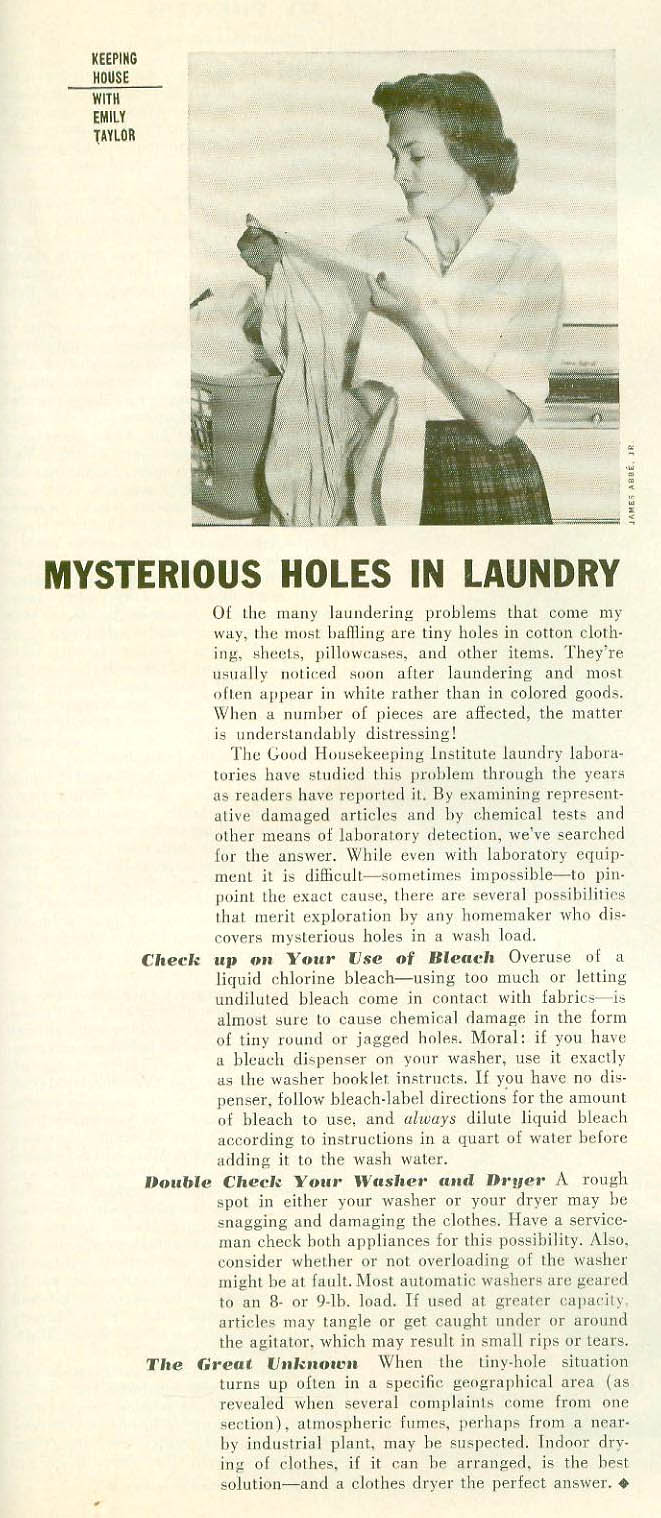
As published in the May 1961 issue of Good Housekeeping...

Of the many laundering problems that come may way, the most baffling are tiny holes in cotton clothing, sheets, pillowcases, and other items. They're usually notices soon after laundering and most often appear in white rather than in colored goods. When a number of pieces are affected, the matter is understandably distressing!

The Good Housekeeping Institute laundry laboratories have studied this problem through the years as readers have reported it. By examining representative damaged articles and by chemical tests and other means of laboratory detection, we've searched for the answer. While even with laboratory equipment it is difficult -- sometimes impossible -- to pinpoint the exact cause, there are several possibilities that merit exploration by any homemaker who discovers mysterious holes in a wash load.
The specifics are contained in the scan below, but note that the big three reasons listed are bleach, the washer and dryer, and "the great unknown".

Tuesday, November 6, 2012

Vote

Your grandmother knew how important it is to vote. She and those before her worked so that women would have the right to vote; don't make it a wasted effort.


Friday, October 26, 2012

Extensions For Blouses

In the June 1956 issue of the Workbasket, Lillian A. Chord sent in this item for the "Women Who Make Cents", a collection of money making ideas readers sent in to the magazine. Chord stated that many of her friends "complained about seams of their blouses showing through skirts and blouses slipping out," so she came up with this with this solution.


The missing text (continued on the next page) reads, "They furnish the material -- and old slip, pajamas or other material -- so I have little cost except my sewing thread and I get fifty cents for each blouse I extend."

Sunday, December 11, 2011

You Can't Afford A Bad Fitting Bra

Our grandmothers may have had better fitting bras than we do today, for a myriad of reasons. I recently spoke with bra coach Ali Cudby and got the scoop. Here's a bit from part two of the interview:

In Chapter Two, in Once Upon A Time, When Fit Was A Fairy Tale, you discuss the fairy tale of fit:
Bra fitting can be confusing because there are so many pieces to literally fit together, and it’s not something most American women are taught — not at home, in school, or anywhere else. There’s no real mechanism for that education. It’s not taught in high school health classes. Many mothers overlook the chance to help their daughters get fit correctly, perhaps because they never experienced the benefits of the right fit themselves.
So poor bra fit is literally passed down through the generations!
There's lots more to learn, including how improper bra fit can cause health problems, how you waste money buying bad bras and more -- and thankfully Ali's put it all in a book for us: Busted! The FabFoundations Guide To Bras That Fit, Flatter and Feel Fantastic. Along with another interview, A Slip Of A Girl is giving away five signed copies of the book -- so go enter!

Friday, December 9, 2011

Shrinking Woolens?

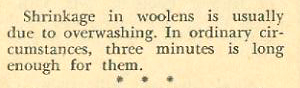
The 1967 American Farm & Home Almanac, edited by Ray Geiger, says that shrinkage in woolens is due to overwashing: "In ordinary circumstances, three minutes is long enough."

Tuesday, November 22, 2011

Eco-Friendly Laundry Tips

When it comes to being eco-friendly, we often have the greatest impact in our daily routines. Laundry is one of those routine chores that most of us have to do several times a week, if not every day. Therefore, even a small improvement can make a huge difference in terms of energy consumption and overall environmental impact. With that in mind, here are eight tips that can help you go green in a big way just washing your clothes.

1. Upgrade to an energy-efficient washer and dryer.


Don’t upgrade unnecessarily, but when it’s time, spend the extra money necessary to buy a high-quality energy-efficient washer and dryer set. Energy Star models can earn rebates as high as $250 under the federal Cash for Clunkers program, and a standard pair can cost as much as $150 more per year in water and power usage.

2. Wash with cold water.


Image Source: Last chance training.

Washing in hot water can use as much as ten times more energy than washing in cold water. In situations where heat is required, such as destroying dust mites for those with allergies, rinsing in cold water can still make a big difference. In fact, the EPA estimates that the average person can save at least $100 per year just by washing in cold water whenever possible.

3. Wash full loads.


Image Source: Dryer Vent Cleaning

Even the most energy-efficient washer and dryer set is going to use about 40 gallons of water and a minimum amount of electricity per load. In other words, every time you do a partial load, you’re throwing money away and using far more water and power than you need to.

4. Hang clothes to dry.

Image Source: Learn That.com

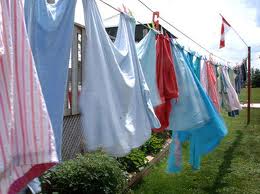
Just because you own a dryer doesn’t mean you have to use it. In fact, by using it sparingly, you can save a considerable amount of money each year while extending the life of your wardrobe. Also, consider using an indoor drying rack. It’s perfect for wintertime or when hanging clothes outdoors simply isn’t an option.

5. Use natural detergents.


Image Source: Latest Wall paper

Many people are reluctant to switch to natural detergents and stain removers due to preconceptions based on outdated information. Today’s natural options are effective and cost-effective. They’re plant-based, biodegradable and specifically formulated to work well in cold water better than synthetic cleaners do.

6. Use homemade detergents.


Image Source: Shabby Art Boutique


It’s possible to make homemade detergent that is more effective and cost-effective than even the store-brought options. Not everyone has the time for that, but there are homemade options that are quick and easy: Vinegar boosts the power of detergents and lemon juice is an awesome stain remover.

7. Use natural softener alternatives.


Rather than use an expensive, environmentally harsh store-brought softeners, use lavender water in a spray bottle and lightly spritz the top of the load before washing. You can also purchase reusable dryer bags, which you can then fill with lavender and other natural softeners and scents.

8. Avoid phosphates and other environmental hazards.


Whatever you use on your clothes, a great deal of it makes it into the ground via backwash. Detergent makers use phosphates because they work and are inexpensive. Phosphates, however, don’t occur in the natural world in their pure form, and at great levels are a hazard to people, animals and the environment.

Thursday, October 13, 2011

Surprise Pumpkin Pie Recipe

From the 1962 Christmas Recipes booklet put out by Wisconsin Power and Light Company, Loreen Jackson, Home Economics Director. This recipe is "an 'Old Hat' idea with a new trim. You will like this up to date version. Texture wise, it's different. The flavor's the same."

Before I share the vintage recipe, I wanted to note a few things... Such as how in 1962, the convenience of store-bought pie shells makes its way into cook booklets from home economics leaders -- but canned pie filling has not. This recipe is a great way to make use of what's left after you carve jack-o-lanterns.


Surprise Pumpkin Pie Recipe

1 9-inch unbaked pie shell
2 cups raw grated pumpkin
2 eggs, beaten
1 cup brown sugar
1/2 cup light cream
1/2 teaspoon salt
1/2 teaspoon cloves
1/2 teaspoon cinnamon
1/2 teaspoon ginger

1. Peel and cut pumpkin into pieces Fill jar of electric blender. Cover with water. Blend for a few seconds until finely grated. Drain thoroughly. May use a fine grater or grinder.

2. Mix all ingredients in order given.

3. Pour into unbaked pie shell.

4. Bake in oven preheated to 425 degrees for 15 minutes. Reduce temperature to 350 degrees and bake an additional 40 minutes, or until center tests done with a silver knife is inserted.

Wednesday, October 12, 2011

How To Keep Paint Fresh In The Can

Another tip from the 1967 American Farm & Home Almanac, edited by Ray Geiger.

Wednesday, August 31, 2011

Reduce Waste

Listia's blog put out this infographic on waste to inform and to inspire more folks to reduce, reuse and recycle, in part by using their site. (My review here.) But obviously, we thrifty folks know we can do this in many ways, be it the old hand-me-downs, passing things to a friend or a neighbor, or making a buck selling things at a yard sale, flea market, or online. Oh, and by reading here at Things Your Grandmother Knew too, of course *wink*

Friday, August 12, 2011

Why We Do Laundry

Getting my kids to change and wash their bedding is such a hassle. Getting my youngest to change his underpants and socks this summer requires spot inspections. I'm certainly not trying to brag! But I suspect others may have similar problems -- if not because they have weird, lazy or even gross kids as I do *wink* but because children and even many adults do not seem to understand why we do laundry.

I think the logic of what my grandma would call the common sense behind laundry, is lost to many today because we have been so conditioned to be consumers who consume -- rapidly

For many, clothing is not a basic necessity, but rather about fashion. Clothing purchases are not a need to replace a practical functioning garment, but are now made out of desire. Ditto linens -- which are now called "home fashions." How many people even think of mending their socks, their sheets -- or, for that matter, how many people have tired of something before it would even need mending? Fabric isn't mended, repaired or even cared for anymore; as fashions textiles have become disposable to so many.

I've nothing against fashion. But I do have to wonder how such a focus on it has twisted perceptions to the point that we don't know how to mend or even why we do the laundry.

Freshly armed from (repeated) lectures to my children, here's the facts.

We launder clothing, linens, bedding, and other fabric items for four reasons:

1.) Hygiene

Along with the things which can creep and crawl into our bedding and textiles, we bring plenty of moisture to the fabrics in our lives. Moisture, whether it's humidity or drool from our mouths, sweat from our skin, or just good old drops of water, is what creates a fertile breeding ground for bacteria, viruses, fungi, protozoa, and microorganisms that can cause disease.

2.) Pride & Respect

More specifically, we wash our clothing and textiles because we have pride in ourselves, in the willingness to take care of ourselves, and we have respect for those we are around. We enjoy looking nice, presenting our homes as looking nice. Culturally, this signals health (including genetic prosperity) as well as being "nice" -- as humans are social animals, being nice means we are more likely to get along with and be accepted by our family members, neighbors, and communities.

Along with looking nice, we want ourselves and our homes to smell nice.

Although perspiration is practically odorless, perspiration can sometimes cause an unpleasant smell when it comes into contact with the normal bacteria on your skin. Bacteria lives on the skin and feeds on our dead skin cells and fluids, such as sweat. Some of these bacteria make chemicals that smell unpleasant, such as methane and hydrogen sulfide. Washing and using deodorants removes these for awhile, but they build up again every day.

We may not be able to smell ourselves; but others will. Since our olfactory senses are designed to detect new odors (changes alerting us to dangers), our continued exposure to our own scents "deaden" our perception of it.  (This is why there are those ladies walking around reeking of perfume and cologne; they can no longer smell it, so they keep increasing how much they put on!) When we wear clean clothes, have fresh linens, we are doing what we can to ensure that we are not offending someone else.

3.) Thrift

Washing fabric -- as directed -- is as act of preservation. It's not just a matter of stains ruining appearance, but every day soiling breaks down fibers, thinning the fabric, making holes, weakening seams, etc.. The longer such simple and often unseen (icky) things as salt crystals from our sweat remain in contact with fabric, the more damage they can do.

For example, not all the holes in socks and hosiery are caused by rubbing against toenails. Abrasions are hastened by the salt crystals, sloughed-off skin cells, good old fashioned dirt, etc. which cut away at the fabric threads. So wash your hosiery after every wearing -- the sooner the better, for as the moisture evaporates, it drys the salts into harder crystals. Or "darn it," you'll have more repairs to mend! (Or more socks and hose to buy.)

This is why tee-shirt necklines, collars, and waistbands fray. It's not just friction against skin; it's the friction combined with nearly invisible but sharp thread-eating dirt, soil, and microorganisms.This is also why phy. ed. uniforms and gym or work-out clothing seems to get so shabby so quickly. It's not just the exertion; it's the lack of washings combined with the (No more having your children only bring their gym clothes home to launder on school breaks!)

Proper laundering removes the soils and prolongs the life of the fabric, which means you have less repairs to make, less things to buy.

4.) Comfort

By now I bet you likely feel far less comfortable in what you are wearing right now! *wink*  But, seriously, we all know how uncomfortable soiled, dirty, smelly, and/or wet clothing is. Hardened or dried bits of things scratch or make us itch.  Spots and stains on our clothing or that of our children and spouses make us embarrassed; we know that people judge (it's an ingrained biological imperative).

Looking nice in clean clothing, having clean sheets on the beds, crisp clean linens on the table, is not a matter of false pride, of trying to appear wealthy or shaming others.  It's something we do for ourselves and our families because physical and emotional health as well as the family budget are at stake.  Doing the laundry just makes good sense. It makes good scents and good cents too. *wink*

Image via Vintage Linen Treasures.

Tuesday, August 9, 2011

Quick Thrifty Links

Whether you opt for paper or plastic, you likely have a lot of those plastic bags... Here's 18 Ways to Reuse Plastic Bags. (Via Girlie Girl Army; sign up for the newsletter here.)

At 3pm, EST, on Thursday, August 11, 2011, @MomCentral is hosting a Twitter party. Topic/Focus: Talk about odor elimination, scent, and how the new Febreze set&refresh refills are designed to provide odor elimination and long-lasting freshness. ( Hashtag: #set&refresh)  And there are prizes: Six people will win $50 Amazon gift codes. Two pre-party promotion winners will also win a $50 gift code.

Wednesday, July 13, 2011

How To Freeze Peas

From the Bureau of Home Economics, United States Department of Agriculture, 1952, how to freeze fresh peas from your garden.

Sunday, July 10, 2011

Links Your Thrifty Grandmother Would Like

How does your garden grow? Information Central: Gardening Questions Answered, by Stephanie Suesan Smith, Ph.D.

Your grandmother would probably like Natural Practical Remedies: Your source for remedies that are practical and/or natural for you and the whole family.

Feel like saving more money? Check out Elemental Cheapness for more ideas.

Also, a contest to win a downloadable file of more than 150 pages of antique images from a 1914 New York Department Store catalog -- for you vintage lovers and creative types.

Things Your Grandmother Knew © 2008 Por *Templates para Você*