Wednesday, November 26, 2008

Make A Vintage Chef Pot Holder Bag

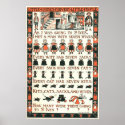
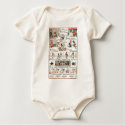
Instructions and pattern for a cute pot holder bag, from Coping Saw Carpentry For Boys & Girls.


Also, keep an eye on the free patterns at Kitschy Kitschy Coo.

***

Free stuff is thrifty, yes? So here are a few more freebies for the holidays:

Christmas for Crafters Giveaway at Junk Creation.

Tree Hugging Family shows you how to get a free digital magazine.

Monday, November 24, 2008

Peeling Pearl Buttons & Other Vintage Accessory Care

Ever find the pearl buttons on your clothing peeling? Well, I found a little blurb about pearl buttons in True Confessions magazine (January, 1936 issue):

To clean pearl buttons, rub with olive oil. Then apply fingernail polish and let it dry. Polish with a buffer or chamois skin.
(I do hope they meant clear nail polish!)

I don't know that I'd recommend the nail lacquer unless the buttons were already peeling or near peeling... But this does seem to explain old buttons I find which seem to be flaky but when rubbed show no damage because it's just old nail polish coming off.

***

Related: I just posted at Collectors' Quest an article on how to select vintage jewelery -- including what repairs can be done. Also there, my Early Plastics: Identification and Care Guide.


Image of the vintage daisy necklace with blue plastic and rhinestones via my shop, We Have Your Collectibles.

Using Your (Egg) Noggin

I don't like eggnog; never have. Hubby and the kids do though, so we always have to buy gallons of it. Every year they say to buy a lot of it because it's the only time of the year it's available -- and every year they swear they'll finish it too. But guess what's left in the back of the fridge once the novelty wears off? Yup, eggnog.

I can't -- won't -- drink it. But I hate pouring it down the drain too... What to do?

Well, thanks to Rachel at Robust Cooking I can now make cookies with it. And I love cookies. Rachel posted about Lehigh Valley Dairy Farms' recipe for Easy Egg Nog Cookies.

All you need is one cup of nog for the cookies, 3 tablespoons for the icing. (And don't forget, if your family leaves behind a lot more egg nog than that, you can make more cookies and freeze them!)

Saturday, November 22, 2008

Gift Project: Hardware Chokers

From the McCall's Needlework & Crafts magazine (Spring/Summer, 1971, issue), comes the instructions to make these hardware chokers.

The supplies needed are strips of suede, self-hardening clay (non-firing), metal hardware (tacks, screws, washers, brads, snaps, etc.), glue, clear nail polish, & paper clips. (May also need incidentals such as needle & thread.)

While I find making gifts can sometimes be as (if not more) expensive than buying gifts, these chokers are worth sharing for several reasons.

One, since they can be made with objects found around the house (in lieu of suede you could opt for other fabric strips), they should be relatively inexpensive; and if you make the gifts together as a family activity, a little extra expense can be seen as a family entertainment expense.

And two, since these necklaces are made with hardware, this craft project is one which may be of more interest to boys. You could also modify the project, replacing the fabric strips with findings for key rings etc., to make more masculine gifts.

Complete instructions available in the last scan.


Thursday, November 20, 2008

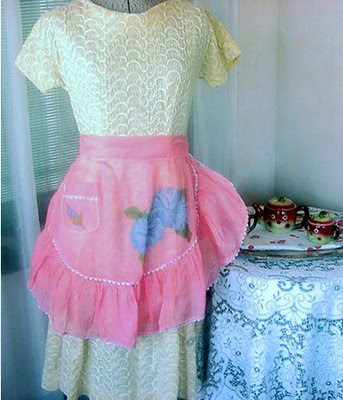
Aprons Rule & Apron Rules

Grandma always said you should be proud of your work around the house; you should be proud to take care of your home and family, and dress to show that pride. While grandma was a lady who liked to dress up, she wasn't the June Cleaver type who wore pearls while scrubbing out the oven or baking cookies (even at holiday time). But she still believed in being properly & attractively dressed for housework.

Like any job, you'll find that work clothes -- a uniform, if you will -- helps while cleaning & cooking. Being properly clad makes one feel dedicated to, prepared for, & protected from the job. Looking & feeling nice makes any job more enjoyable too. Not only that, being able to change out of those work clothes helps one leave the job -- even if they don't leave the work site when they are done with their shift (as if it's ever really done!)

One of the staples grandma recommended, naturally, was the apron.


Sure, they can be absolutely adorable and therefore bring a smile to your face even if it is sticking inside a dirty oven (or is that just the fumes from the cleaner?), but they are incredibly practical. That is, aprons are practical if you are using them correctly.

Here are my apron rules, as grandma and experience taught me.

Bib aprons are nearly always the most practical. They cover more, and so protect your clothes better from splatters of food and cleaning products. They also almost always have nice big pockets. This means you can keep personal care items like hankies and tissues near, keep a small notepad & pen inside for writing notes and shopping lists wherever you are, tuck the end of a kitchen towel in the pocket so you can always dry your hands when the phone rings -- and nowadays, even keep your cellphone there.


Why would anyone choose a standard apron when there's a bib apron? Aside from the obvious times when you are playing hostess or otherwise wish to show off more of your outfit, there are some chores, like dishes for example, in which splashes are most likely to only occur at or below your waist. There are also times when you really just want the pockets or you just like the feeling of putting on your work attire; and some people just don't like the extra layer on top.


Whatever style suits you for working in, choose aprons made of sturdy cotton. Poly blends may be thought of as more likely to remain more stain-free, but many man-made fibers (especially the vintage varieties) actually stain worse than cotton and react more quickly to the heat of the stove & appliances -- including melting & burning into your skin & clothing. Cotton is also more absorbent than such man-made blends (or plastics); and cotton breathes -- if you're working so hard you'll appreciate it!


The only time wearing an apron is not recommended to be worn while working is for scrubbing those floors or other chores which may have you on your knees. Not only will you likely soak the apron quickly (and anything in the pockets too), but the chances are very good that while crawling around your knees will 'catch' the apron, either ripping it or jerking you around the neck &/or waist -- maybe all of the above. Grandma warned me about that; but I had to learn the hard way. :sigh: You're better off removing the apron before you begin -- you can always put it back on again.

Frilly aprons which do not wash well may be cute, but they are called hostess aprons for a reason: you wear them primarily for show. But they do offer a place to wipe your hands in a pinch, so they are helpful to the hostess while serving.


A word about apron etiquette: Aprons are not to be worn at the table or, in the case of buffet style service etc., not to be worn while eating. Not only is this like wearing a hat at the table, but it does not signal that you are relaxed and enjoying your family &/or guests. Your guests will only be at their most relaxed, ready to enjoy your meal, if you, the hostess, are relaxed and enjoying your meal. So wear it serving, and then remove it before you sit down to eat.

Do not hesitate to remove any apron, be it a hostess apron or a work apron, once it gets dirty or wet. Changing aprons several times may be as likely and necessary as changing hand towels in the kitchen or bath. There's no sense in allowing the gunk on your apron to soak through to your clothes or drip onto (and contaminate) your recently cleaned surfaces &/or food; nor is there any sense in making yourself uncomfortable.


You may be thinking that with all this wear that you're better off just to have ratty 'work aprons' which remain stained & are only replaced when they are falling apart; Grandma and I couldn't disagree more.

One of the reasons aprons are worn is to show pride. You should care enough about your clothes to want to protect them, yes; but you should also care enough about yourself to feel good, clean & pretty in a good, clean & pretty apron.

So change your apron often, wash it often, and once it's served it's usefulness -- including as an attractive garment -- stop wearing it.

Thirteen Uses For Bacon Grease

Growing up, I was always told to never, ever, rinse or scrape greasy skillets and pans into the sink and down the drain -- you'll clog the pipes! You're to scrape them clean first and then rinse them with hot-hot water to make sure to avoid clogs.

But as many a good (and economical) cook knows, you don't scrape that bacon grease into the garbage can either; you save it for some savory cookin'.

First the 'how' and then the cooking ideas.

How:

When done frying the bacon, take the skillet off the heat & wait for it to cool -- really cool. Hot grease splatters are no fun at all.

When you are certain the grease is room temperature (it's hardened), scoop into a glass container, a coffee can, or plastic container. (And yes, scrape that skillet -- those bits of bacon in the grease are 'gold' as far as flavor goes!) Then cover the container and place in the fridge.

It may not look like much in the container at first (either in terms of amount or appeal), but eventually it not only adds up, but adds a nice flavor to foods.

Note: when using bacon grease do not add any additional salt while cooking or baking.

Now here's 13 ways to use that bacon grease.


The first 10 ideas are from Modern Woman Magazine (Vol. 12, No. 4, 1943)


11) Add to mashed potatoes, and then you can cut the amount of butter &/or milk as well as add flavor. (In fact, adding a tsp. of bacon grease to a boiling pot of potatoes keeps the water boiling in the pot -- not have to boiling over onto the stove top -- and adds zing.)

12) Use it to grease your muffin tins for corn muffins, the baking sheet for biscuits, etc.

13) Fry sliced (green?) tomatoes! (Fannie Flagg's Original Whistle Stop Cafe Cookbook: Featuring : Fried Green Tomatoes, Southern Barbecue, Banana Split Cake, and Many Other Great Recipes)

Have your own recipes or ways to use bacon grease? Please share them in the comments!

Get the Thursday Thirteen code here!

The purpose of the meme is to get to know everyone who participates a little bit better every Thursday. Visiting fellow Thirteeners is encouraged! If you participate, leave the link to your Thirteen in others' comments. It’s easy, and fun! Trackbacks, pings, comment links accepted!

Wednesday, November 19, 2008

Wardrobe Thoughts: When Saving Isn't Saving

In How To Dress Well On Practically Nothing, the author of the blog Couture Allure Vintage Fashion discusses a regular dressing on a budget feature in Ladies Home Journal -- specifically the column which ran in the October 1959 issue.

She writes:

The focus here is on investing in practical but versatile basics that you can accent in different ways with accessories. Mollie's coat wardrobe is complete with one tweed for everyday, a white dressier version, and an evening wrap. How many coats are in your closet? How many dollars have you invested in trendy styles, inexpensive fabrics, or unusual colors that don't work for everyday? Isn't it wiser in today's economy to spend more money on one practical coat in a high quality fabric and basic color that can be worn for years? A change of accessories changes the look in a few seconds.

Our mothers and grandmothers got along with far less clothing than we do today. Each piece of clothing was a carefully considered investment that was meant to last for several years, not several months.
This echoes the sentiments of my father, who always sighed (and argued and mocked) my mother's clothing purchases. He was (and still is) an advocate of building a wardrobe, not just buying garments because they were 'cute' or otherwise desirable -- or even on sale.

When my mother came home from the mall with bags, gleefully chattering about how this sweater was only $9.00, this skirt 50% off, these earrings too cute to pass up 'at that price', and "at $2 a pair, I had to get 3 pairs of gloves!" my father would sarcastically ask, "Just how much did you 'save' with all those bags?" (And he'd sue air quotes for emphasis too.)

When mom would reply with her total, he'd point out how she could have done better. For that amount -- no matter what the amount -- not only could she have had a better quality sweater, suit, etc., but one which was more practical too. And it was true.

For nearly every bargain $9.99 sweater she 'saved' $10 or more on, she had to run back to the mall for a skirt or jacket or slacks which would match it; it was no wardrobe item, but just a piece of clothing. And she had more sweaters in her dresser drawers (and boxes slid beneath the bed) than she could wear in two Midwestern winters.

For a $50 shopping spree of, for example, say 4 items at a 'savings' of another $50, she could have had one nice sweater, skirt, blazer etc. which would last her for years.

And how many pairs of gloves does a person need? Perhaps two (one at home and one in the car for adults; one to wear while the other pair dries for children). At such 'bargain' prices, mom (and all of us) would have been better off saving the $6 (or $16, if you count the number of gloves already owned) on cheap gloves to purchase one pair of more expensive, better quality gloves which would keep her hands warmer, wash better, & last longer. (Not to mention the money she'd then save not having to buy matching or co-ordinating scarves and hats!)

Mom still hasn't learned this. She still buys 'cute things at bargain prices' without thinking of building a wardrobe which will serve her -- or her budget -- well.

But me? I know better.

Living Green, Buying Organic

Jason Chatraw at RiverWired reviews E Magazine's Green Living, and includes this tip from the text on how to ensure you're looking at & buying organic produce:

While at the produce counter, you can tell whether a zucchini or a Hawaiian-grown papaya are genetically engineered or organic by employing this little-known strategy: Look at the code printed on the tiny sticker stuck on the produce. If the PLU code begins with the number 9, it’s organic. Conventionally grown fruits and vegetables bear a code beginning with 4. If the code begins with an 8, the produce is genetically engineered—making this the only genetic engineering label in the United States. While this numbering system is handy for ensuring that you picked up organic fruit instead of the conventional variety, it’s unlikely that you’ll pick up a piece of genetically engineered produce. Very few varieties are sold.
Ah, of such things our grandmothers could not have known.

Tuesday, November 18, 2008

Tips For Mending & Sewing Patches On Pants

Need help sewing patches and appliques onto jeans?

In Your Hint Exchange, (Eleanor Spencer, McCall's Needlework & Crafts, Spring-Summer 1971), the advice for mending jeans & slacks with small legs is to insert a rolled-up magazine into the leg, then unroll it making it easier to fit, pin & sew neat patches.


In Household Ideas: Prize Hints for the Homemaker (Modern Woman Magazine, Vol. 14, No. 5, 1945), the suggestion is to open the pant leg at the seams so that the fabric will lay flat. Mend &/or patch, then restitch the seam on the sewing machine.

Soup Stock

Another vintage household tip, this from Modern Woman, Vol 14, No 5, 1945.

When you buy macaroni, dried beans, peas, rice, etc., take out 2 tablespoons and put in a separate jar. When you are ready to make soups, you can use this mixture without having to buy a lot of separate items, requiring too many points.

Painting Upholstery, Carpet & Canvas

When I spotted this article by Louise Price Bell in Modern Woman (Vol 12, No 4, 1943), I was tempted to save it for posting in spring because it's about painting garden, porch & patio furniture and rugs. But then I realized that painting techniques like this offer cheaper alternatives to reupholstering chairs & having new carpeting or other floor coverings installed to easily spruce up the place for holiday gatherings and knew I had to share it now.


Frankly, the article on "canvas paint" rather blew my mind. I knew of fabric paints for making crafty tee-shirts & canvas shoes, but I had no idea there were paints sturdy enough for more rugged action. While I couldn't find the exact product (Setfast), I did find several DIY sites which recommended those same fabric paints as well as latex -- and there's even a spray upholstery paint.

If the idea of painting the spotted &/or stained fabric on furniture (even if the seats etc. are not removable), excites you; if getting a cheap indoor/outdoor rug, painting it and throwing it over the worn hallways (and even just plain old bad carpeting) just in time for the holidays is just too delightful; then here's some additional how-tos & info:

Hate The Fabric Colour? Just Paint It!, says the Ikea Hacker.

Some basics are at eHow's (How To Paint A Sisal Rug), Real Simple (Makeover Your Rugs with Paint), and Curbly (How To Paint An Indoor-Outdoor Rug).

At TLC, Jeff Beneke's Paint The Rug, Or Not discusses which carpet may or may not be suitable to paint.

Things Your Grandmother Knew © 2008 Por *Templates para Você*