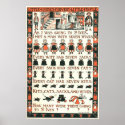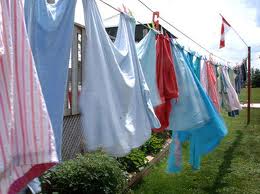

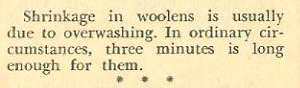
The 1967 American Farm & Home Almanac, edited by Ray Geiger, says that shrinkage in woolens is due to overwashing: "In ordinary circumstances, three minutes is long enough."
Friday, December 9, 2011
Shrinking Woolens?
Posted by Deanna Dahlsad
0
comments
Labels:
Clothing,
Household Tips,
Waste-Not
Tuesday, November 22, 2011
Eco-Friendly Laundry Tips
Posted by Deanna DahlsadWhen it comes to being eco-friendly, we often have the greatest impact in our daily routines. Laundry is one of those routine chores that most of us have to do several times a week, if not every day. Therefore, even a small improvement can make a huge difference in terms of energy consumption and overall environmental impact. With that in mind, here are eight tips that can help you go green in a big way just washing your clothes.
1. Upgrade to an energy-efficient washer and dryer.
Don’t upgrade unnecessarily, but when it’s time, spend the extra money necessary to buy a high-quality energy-efficient washer and dryer set. Energy Star models can earn rebates as high as $250 under the federal Cash for Clunkers program, and a standard pair can cost as much as $150 more per year in water and power usage.
2. Wash with cold water.
Washing in hot water can use as much as ten times more energy than washing in cold water. In situations where heat is required, such as destroying dust mites for those with allergies, rinsing in cold water can still make a big difference. In fact, the EPA estimates that the average person can save at least $100 per year just by washing in cold water whenever possible.
3. Wash full loads.
Even the most energy-efficient washer and dryer set is going to use about 40 gallons of water and a minimum amount of electricity per load. In other words, every time you do a partial load, you’re throwing money away and using far more water and power than you need to.
4. Hang clothes to dry.
Just because you own a dryer doesn’t mean you have to use it. In fact, by using it sparingly, you can save a considerable amount of money each year while extending the life of your wardrobe. Also, consider using an indoor drying rack. It’s perfect for wintertime or when hanging clothes outdoors simply isn’t an option.
5. Use natural detergents.
Many people are reluctant to switch to natural detergents and stain removers due to preconceptions based on outdated information. Today’s natural options are effective and cost-effective. They’re plant-based, biodegradable and specifically formulated to work well in cold water better than synthetic cleaners do.
6. Use homemade detergents.
It’s possible to make homemade detergent that is more effective and cost-effective than even the store-brought options. Not everyone has the time for that, but there are homemade options that are quick and easy: Vinegar boosts the power of detergents and lemon juice is an awesome stain remover.
7. Use natural softener alternatives.
Rather than use an expensive, environmentally harsh store-brought softeners, use lavender water in a spray bottle and lightly spritz the top of the load before washing. You can also purchase reusable dryer bags, which you can then fill with lavender and other natural softeners and scents.
8. Avoid phosphates and other environmental hazards.
Whatever you use on your clothes, a great deal of it makes it into the ground via backwash. Detergent makers use phosphates because they work and are inexpensive. Phosphates, however, don’t occur in the natural world in their pure form, and at great levels are a hazard to people, animals and the environment.
Thursday, November 10, 2011
Free Copy Of The DinnerRevolution
Posted by Deanna DahlsadChef Jeff is giving away free copies of his latest book, DinnerRevolution. These recipes from Chef Jeff Pirtle of Mydietchef.com are super family-friendly, healthy, have less than 10 ingredients, and take less than 30 minutes to prepare. The ebook has a $27 value, so grab your free copy here! Oh, and the book is the 2.0 version he's counting on us to give feedback for the final, 3.0 version; so send your thoughts in to him.
0
comments
Labels:
Bargains,
Cooking,
Food,
Recipes
Wednesday, November 9, 2011
How To Whip Wax To Frost Candles
Posted by Deanna DahlsadInstructions on how to frost candles with whipped wax from The Glo Candle For All Occasions, The Glow Candle Co., Kansas City, Missouri; copyright 1952 and 1956 by Consumers Cooperative Association. ("Special credit is given to Noma Glahn whose ideas, experiments and cooperation helped make this booklet possible.") Note the tips for decorating with sugar, glitter, and paint too.
0
comments
Labels:
Crafty,
Home Decor
Friday, October 28, 2011
Meatless Italian Dishes From Chef Boyardee
Posted by Deanna DahlsadMeatless recipes from a vintage Chef Boyardee cook booklet titled Famous Italian Dishes, by Chef Hector Boiardi -- with Recipes tested and approved by The Chef Boy-ar-dee Housewife, Lois Nichols. These meatless recipes were not for the benefit of vegans or even wartime rations. No, these inexpensive and tasty dishes to take the place of meat, "thereby making Friday or Lenten Season dishes of them."
0
comments
Labels:
Cooking,
Food,
Recipes
Thursday, October 27, 2011
Make A Recipe File
Posted by Deanna DahlsadFrom 4-H Food Preparation, Extension 4-H Bulletin #32, dated June 1952, by Mary R. Anderson and Grace D. Brill (a 4H Club booklet put out by the University of Minnesota, Agricultural Extension Service, U.S. Department of Agriculture, University Farm, St. Paul 1, Minnesota), information on two types of recipe files, how to make them, and how to use them.
0
comments
Labels:
Books,
Cooking,
Crafty,
Household Tips,
Recipes,
Traditions,
Vintage Living
Tuesday, October 25, 2011
The Worst Thing About Fruit? The Fruit Flies
Posted by Deanna DahlsadThe worst thing about fresh fruit is the darn fruit flies. I know, because we've been hit - arg!
Normally, they seem to live and die and cease to be a problem, but this time...
I'm not one to tolerate bugs or insects of any variety in my home. Especially having just been battling with the icky Box Elder Bugs this fall.
Zero.
Tolerance.
So first I grabbed a left-over roll of the sticky fly tape.
But it didn't seem to be working fast enough for me. (Patience may be a virtue, but so is a house free of fruit flies!)
My complaints spurred on the hubby who went and created The Farm Version Of The Fly Trap.
This trap is based on the bait method; a bit of fruit juice in the bottom of a clear glass jar (another excellent reason to keep baby food jars!), with a funnel of paper taped at the opening. You can modify this by using wine, sugar water, etc. -- any sweet and fermenting liquid will work.
The theory behind this natural method of ridding your house of fruit flies is that the flies will be lured to the sweet stuff, flying into the wide opening of the paper funnel mouth but, as the end narrows near the liquid, they will land in the liquid and drown.
It's a theory, anyway.
The fruit flies we had seemed to not only survive the death trap (including, when one did manage to die in the juice, other fruit flies standing upon the dead body of their fallen comrade to partake of the juice), but thrive. Yup, after two days of watching the damn things walk around inside the jar, I concluded that The Farm Method of fruit fly removal was more like feeding and perhaps breeding than ridding us of the pests.
Seriously, other than my concerted efforts to spot them near the tape and smush or imprison them, they seemed to proliferate.
I again brought hubby into the bathroom, told him my (obsessive) observations, and asked him if he had any modifications up his sleeves. When the answer was, "Nope," I has him disassemble the contraption and just left the store-bought fly paper roll there and tried to ignore it all.
Two days later, food and beverage gone, the fruit fly population not only dwindled, but the infestation seemed to be over. (Though I'm keeping the ugly roll up a few more days, just to be sure...)
While The Farm method sure looks better than a long unwound roll of sticky tape with dead insects on it, it just didn't work. And while you can argue that The Farm method is more natural, and/or, pending on the manufactures of all the items in question, more environmentally friendly, I myself just wish to be rid of the icky insects.
PS I've filed this under Advice From My Grandma because hubby learned this from his mother and grandmother and that's close enough for me! *wink*
Saturday, October 22, 2011
Icing Too Grainy?
Posted by Deanna DahlsadIn the 1967 American Farm & Home Almanac, a tip on adding a pinch of salt to your icing recipe so that it will not sugar or grain when it dries on the cake or baked goods.
0
comments
Labels:
Cooking,
Recipes
Friday, October 21, 2011
Knit Turkeys Fit For A Child
Posted by Deanna DahlsadA sweater with turkey on it to knit for children -- just in time for Thanksgiving. Maybe? Or next year... This pattern is from the March 1956 issue (Vol 21, No 6) of The Workbasket; another pattern, for bunny booties, is here!
0
comments
Labels:
Clothing,
Needlework
Tuesday, October 18, 2011
Recommended Serving Sizes, Chilling Times & Uses For Jell-o Gelatin
Posted by Deanna Dahlsad
0
comments
Labels:
Food,
Recipes
Monday, October 17, 2011
Sandwiches & Butter Balls, 1914
Posted by Deanna DahlsadSandwich recipes, circa 1914, from The Drexel Institute of Art, Science & Industry.
Photo of young women outside the Drexel Institute in the 1930s; via.
0
comments
Labels:
Cooking,
Food,
Recipes,
Women